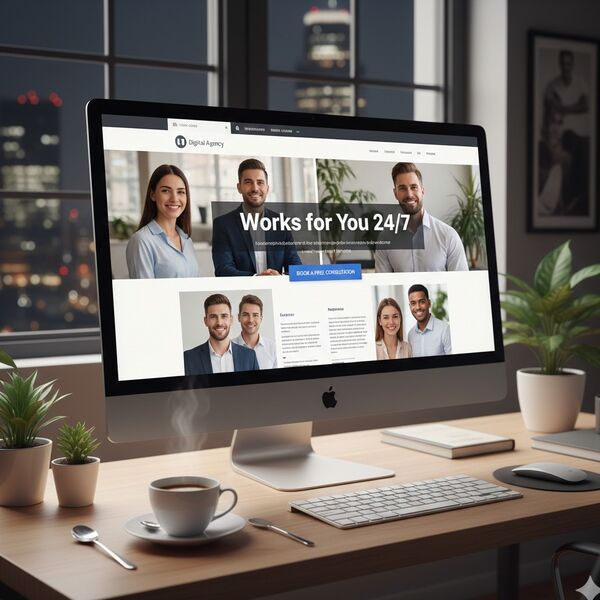
Most small business websites are digital brochures. They list some services, show a few photos, include an "About Us" page nobody reads, and stick a phone number in the footer. Then the business owner wonders why the website doesn't generate any leads.
Here's the problem: a brochure sits on a table and waits to be picked up. A salesperson walks up to you, understands your problem, and guides you toward a solution. Your website should be doing the same thing — actively moving visitors through a journey that ends with them becoming a customer.
Let's talk about how to make that shift.
The Brochure Mindset vs. The Salesperson Mindset
A brochure website says: "Here's who we are and what we do. Call us if you're interested."
A salesperson website says: "I understand your problem. Here's how I solve it. Here's proof it works. Here's what to do next."
The difference is subtle but transformative. A brochure is passive — it presents information and hopes the visitor figures out the rest. A salesperson is active — it anticipates questions, addresses objections, builds trust, and makes it effortless to take the next step.
Think about the best salesperson you've ever encountered. They didn't just recite product specs. They listened to what you needed, showed you why their solution was the right fit, and made buying feel natural. Your website can do all of this — if it's designed with intention.
Lead With the Problem, Not Your Logo
Most business websites open with something like "Welcome to [Business Name]" or a vague tagline about "quality service since 1997." Your visitor doesn't care about your history — at least not yet. They care about their problem.
The first thing a visitor should see when they land on your site is a clear statement that resonates with their situation. Something like:
- "Tired of waiting weeks for a contractor who actually shows up?"
- "Your back pain shouldn't run your life."
- "Stop losing customers to a website that loads slower than your competition."
When someone sees their problem articulated clearly, they immediately think: "These people get it." That's the first step in the sales process — establishing relevance and empathy.
Guide the Journey With Strategic Layout
A great salesperson doesn't dump all the information at once. They guide the conversation in a logical order: problem → solution → proof → action. Your website should follow the same structure.
Section 1: Hero — State the problem and promise. "We build websites that actually generate leads for local businesses." Immediately, the visitor knows what you do and who you do it for.
Section 2: Services / Solution — Show how you solve the problem. Not a laundry list of features, but outcomes. Don't say "responsive design" — say "your site looks perfect on every device, so you never lose a mobile customer."
Section 3: Social Proof — Testimonials, case studies, results, logos of businesses you've worked with. This is where trust is built. People believe other customers more than they believe your marketing copy.
Section 4: Process — Show them exactly how it works. "Step 1: We have a call. Step 2: We build your site. Step 3: You review it. Step 4: We launch." Reducing uncertainty makes people more likely to take action.
Section 5: Call to Action — Make it crystal clear what they should do next. "Book a Free Consultation" or "Get Your Free Quote." One primary action, impossible to miss.
Every Page Needs a Job
Here's a litmus test: for every page on your website, you should be able to answer the question, "What is this page's job?" If you can't answer that clearly, the page is a brochure page — it exists but it doesn't do anything.
Your homepage's job is to make a strong first impression and drive visitors deeper into your site. Your services page's job is to show that you can solve their specific problem. Your about page's job is to build credibility and human connection. Your contact page's job is to make reaching out feel effortless.
Every page should have one clear call to action that aligns with its job. Don't give visitors five different things to do — give them one obvious next step.
Address Objections Before They're Raised
A good salesperson knows the common objections and addresses them proactively. Your website should do the same.
"How much does it cost?" — If you can't list exact prices, at least give ranges or say "projects typically start at $X." Hiding pricing creates friction and distrust.
"How long will it take?" — Include timeline information. "Most projects are completed in 2-3 weeks." Specificity builds confidence.
"What if I don't like it?" — Address risk. "We offer unlimited revisions" or "You don't pay until you're satisfied." Reducing perceived risk dramatically increases conversion.
"Are they any good?" — This is what testimonials, case studies, and portfolio pieces answer. Let your past clients sell for you.
An FAQ section isn't just helpful for visitors — it's a powerful sales tool that handles objections at scale, 24 hours a day.
Make Contact Effortless
You would never hire a salesperson who, when a customer says "I'd like to buy," replies with "Great, go find the order form, fill out 15 fields, and maybe I'll get back to you next week."
Yet that's exactly what many websites do. The contact form is buried on a separate page. It asks for information you don't need. There's no phone number visible. The response time is unclear.
Your contact method should be visible on every page. The form should ask for the minimum viable information — name, email or phone, and a brief message. Include your response time: "We respond within 2 hours during business hours." Make the phone number clickable on mobile. Consider adding a booking calendar link so they can schedule a call directly.
Every unnecessary step between "I'm interested" and "I've made contact" is a step where you lose potential customers.
Your Website Works While You Sleep
The most powerful thing about treating your website like a salesperson is that it never takes a day off. At 2 AM on a Sunday, when someone's toilet is flooding and they search "emergency plumber," your website is there. When a small business owner lies awake at 11 PM thinking about their terrible website and Googles "web designer near me," your site is making the pitch.
But only if it's designed to sell — not just to sit there looking pretty.
At Ridgemark Digital, every website we build is designed with conversion in mind. We don't just make beautiful sites — we build digital salespeople that work 24/7, guiding visitors from curiosity to contact. Because a website that doesn't generate business is just an expensive online business card.